Rosati Ice
Cart Rental Program Strategy
UX Strategist
Role
Timeline
February 2025 - Present
Evolving service; 2027 planning in progress
Status
UX strategy
Service design
Information architecture
Visual design
Content strategy
Operational planning
Scope
Adobe
Powerpoint
Docs
Gamma
Claude
Tools
Heuristic Evaluation
Competitive Analysis
Webpage copy
Social Media/Marketing Materials
Stakeholder Presentations
Strategy Plan
Interview Docs
Deliverables
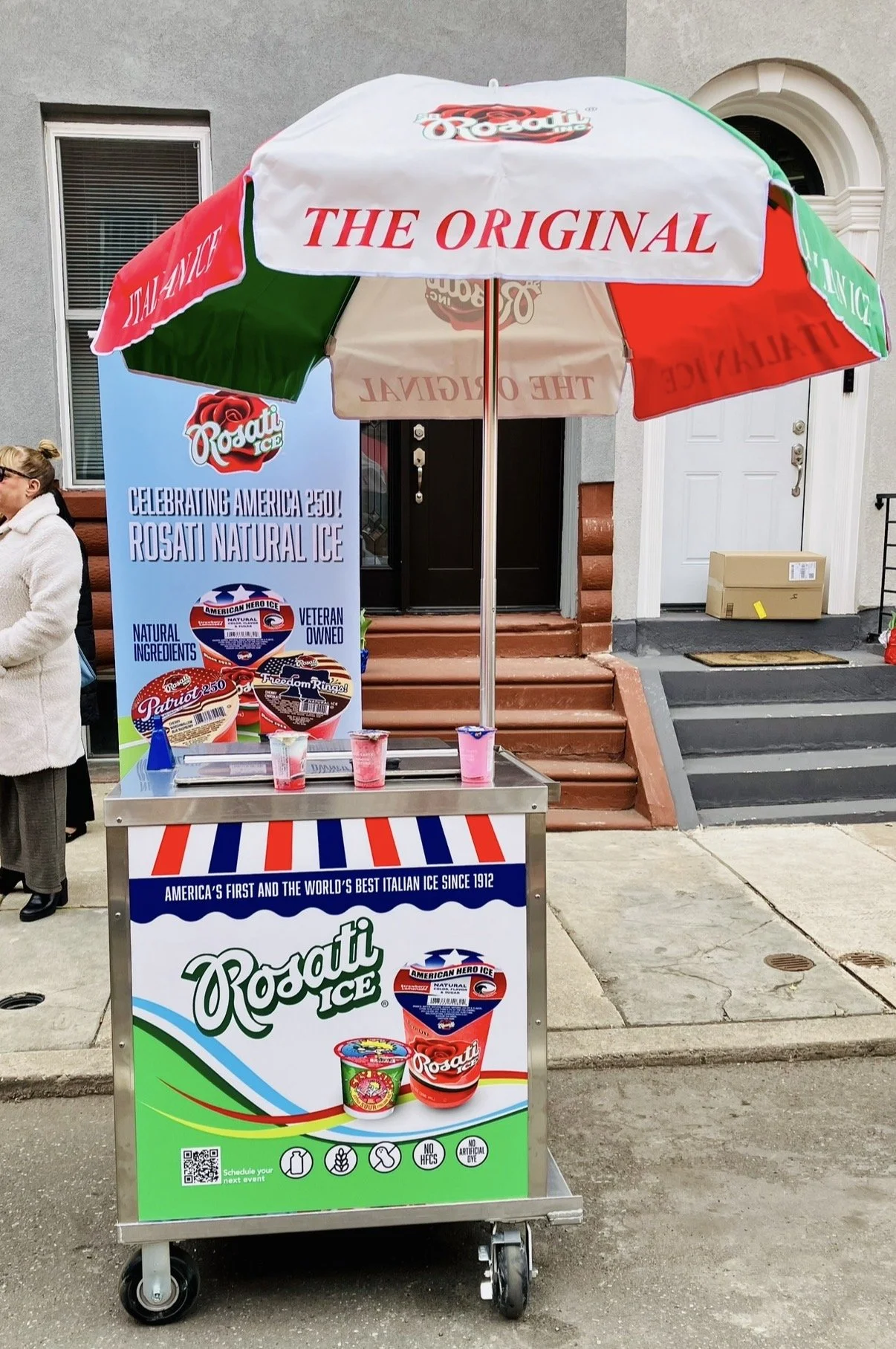
Rosati Ice, America’s first Italian ice brand, wanted to bring its product directly to parties, schools, and community events. For several years, the CEO tried to acheive this through a fundraising program, but it came with many pain points and did not produce the results he hoped for in booking numbers or profitability.
The CEO saw an opportunity to pivot to a more scalable and profitable cart rental model: a “click, click, buy” experience where customers book a stocked cart online and Rosati delivers it without needing to staff the event. Instead of pre-selecting individual cups, a pre-selected cart package would be purchased and dropped off to reduce friction and ease execution.
In 2026, we pivoted our attention away from the fundraiser program and began building the cart rental program from the ground up. We needed to decide which packages to offer, what each one included, where we could deliver, and what would happen between payment and pickup. The goal was to make booking simple for customers while creating a process our small team could fulfill consistently.
Context
As Rosati’s first UX strategist, I joined the fundraising project in 2025, conducting a heuristic evaluation of the current fundraising page, refining copy, identifying pain points in the booking process flow, and attending a fundraising event to locate pain points and successes firsthand. I also organized the brand’s typography, imagery, and hex codes into a shared brand library, which I used to create more consistent marketing and social media materials for both fundraising and non-fundraising events.
When the team shifted toward cart rentals at the start of 2026, I helped turn the CEO’s “click, click, buy” vision into a customer journey the team could support. I reviewed competitors, organized the rental packages, wrote and refined webpage copy, and mapped the steps from choosing a cart through delivery and pickup to naturally reflect the user’s mental model. I handed the content to the web designer and revised it with the team in weekly meetings.
I also supported the social media manager with cart rental content and served as a shared point of contact for influencers and cart art designers working with Rosati on the program. Across those touchpoints, my focus was to make the experience feel simple and exciting for customers while giving Rosati’s small team the information it needed to fulfill each rental.
After a strong first season, I'm now building on that foundation today by developing a 2027 plan that runs from marketing all the way through event-day execution. Through user research with key stakeholders, I'm mapping the full customer journey and building a service blueprint that connects marketing, booking, fulfillment, and post-event feedback.
Role
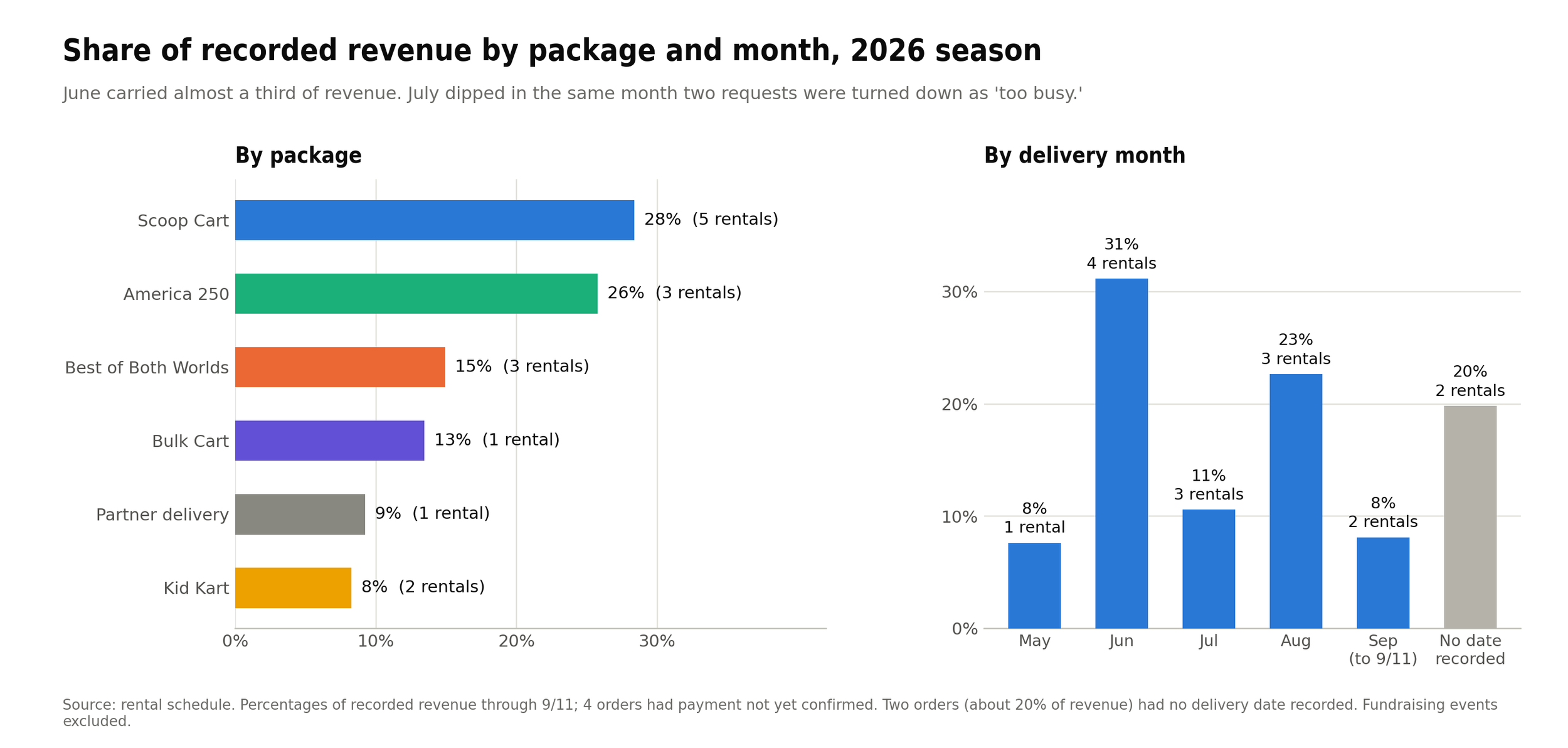
Since it’s first booking in May, the first 2026 season outpaced capacity of Rosati’s single cart. Bookings between May-September produced 15 completed rentals and 4 more requests turned away due to pain points being addressed currently - missed emails, unclear service area boundaries, and the potential for a cart to be completely unattended. Events ranged from backyard parties to a University of Pennsylvania event and a Philadelphia 250 block party covered by all four local news stations. Customers describe the process as "super easy," and one client has already rebooked for next year. Building on that momentum, the CEO is aiming for 50 rentals in 2027.
Results
The Problem
In early 2026, Rosati set out to build a cart rental program from the ground up. At the time there were no packages, no booking flow, no delivery process, and a small team already stretched across the rest of the business. As the UX Strategist, I saw two problems that had to be solved together. Customers needed an experience that felt effortless, where they could find the right cart for their event, understand exactly what they were getting, and book without picking up the phone. And the team needed a program they could actually run, one that didn't depend on outside vendors, last-minute decisions, or a lot of hands-on work at every event.
Rosati's fundraisers had already shown what happens when those two sides fall out of balance. Too many individual choices confused guests and slowed down staff, and relying on outside mobile vendors to distribute the cups alongside non-Rosati frozen novelty items blurred the brand. Pain points were prevalent: families had to prepay online for individual cups, students needed QR codes to collect them, and an outside vendor operated the truck under a different name. In practice, most children arrived without their codes, a Rosati staff member had to attend to support the vendor in matching each individual to their pre-selected cup flavor, and outside guests could not buy ice spontaneously on the day of the event. So the challenge wasn't just designing a rental page. It was designing a service that's simple on the front end and repeatable behind the scenes.
That became my guiding question: How might we make booking a cart easy for customers, while making every rental easy for a small team to deliver?
Early-stage Strategy
January 2026 - August 2026
I spent time in early 2026 exploring the websites and social accounts of two competitors who have cart rental programs the CEO aspired to replicate. I started a messy brainstorming doc and wrote down everything that caught my attention: how their navigation and banners guided people, how event pages led to rental packages, the language they used, and where they drew the line between cart and truck rentals. I even noted smaller details, like one company offering a 48-hour drop-off cart without service and the other letting customers choose the look of their cart. Once I had it all in front of me, I pulled out the patterns and sent the team a short summary of my UX recommendations.
Competitive Analysis
I also looked closely at the closest thing Rosati had to a rental program: its fundraisers. I had seen the process in person, and the small points of friction added up. As we planned cart rentals, I kept asking how we could make the experience easier to repeat with a small team: fewer decisions for customers and less hands-on coordination at each event.
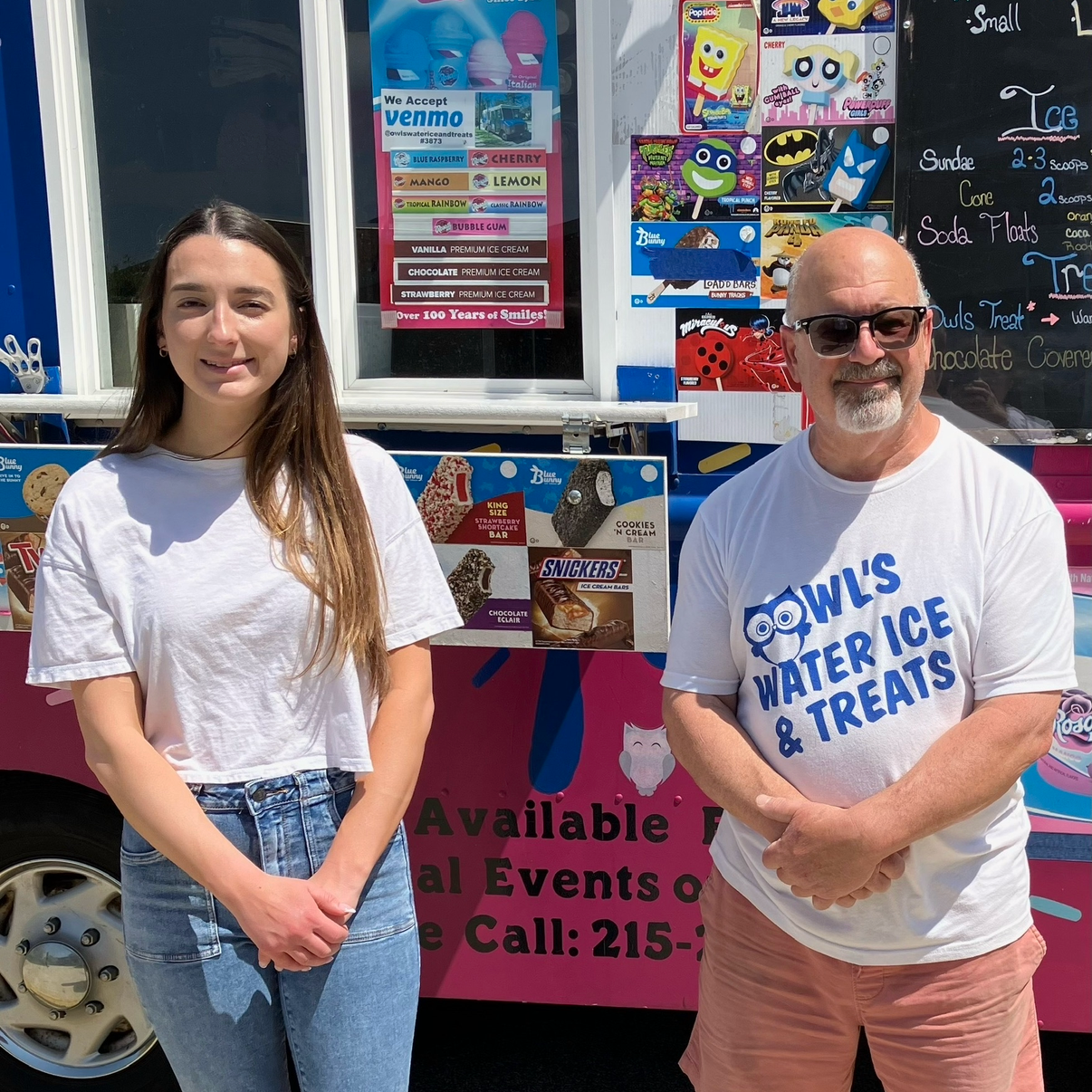
Rosati Ice fundraiser I attended. External products and non-applicable payment method present on mobile vending partner's van.Customer Journey & Webpage Design
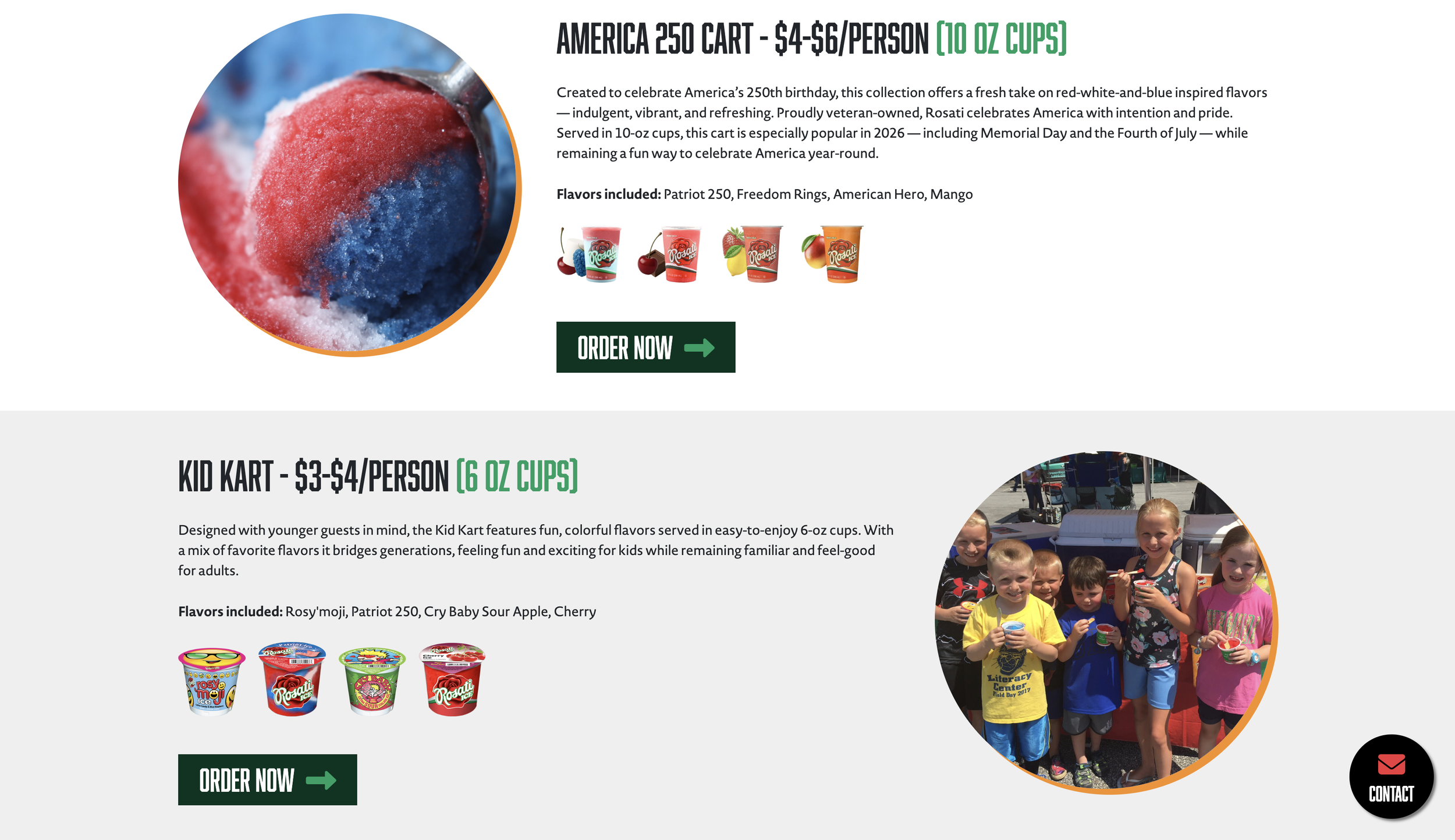
I used my competitor research to think about cart packages from the customer’s point of view. Someone planning a birthday party is more likely to start with the occasion than with a cup size or serving format. I drafted options around the kinds of events Rosati wanted to serve, considering flavors, portions, and what each package would include, noting historical best sellers with the company for each audience and diversity in flavors. For example, the “Kid Kart” package intentionally featured cups historically popular at the company with kids: an emoji-themed cup, an iconic “Cry Baby” sour ice cup, classic red/white/blue, and a standard cherry.
Leadership and I refined them over several rounds and landed on four distinct cart rental packages. Rather than creating a separate package for every event size, we used dropdowns so customers could choose a serving quantity that fit their gathering. The CEO set the pricing; my focus was on making the options easy to compare while leaving room for different group sizes.
I carried those decisions into the rental page. The CEO’s “click, click, buy” vision gave me a clear goal: help guests choose and book without making them sort through unnecessary steps. This required determining what information Rosati needed to fulfill an order so we could collect the necessary details without complicating booking. Too many non-urgent or irrelevant fields was something I noticed on competitor sites, and had made adjustments to our own fundraising page in 2025 as well through heuristic evaluation and customer feedback.
I wrote copy that kept the celebratory feeling of the rental while answering practical questions about what was included, such as cups but no scoops, and what would happen next. I addressed common confusions upfront, and wrote a FAQ page based on input from a team member who often was the point of contact for phone calls with Rosati questions.
I mapped the journey from selecting a cart through reservation, payment, delivery, and pickup, then used Adobe to find icons that made each step recognizable at a glance on both the site and social media/marketing materials. I handed the copy and icon direction to the web designer and reviewed the page with the team in weekly meetings. As package and fulfillment details changed, we revised the page so what customers saw online continued to match what Rosati’s small team could deliver.
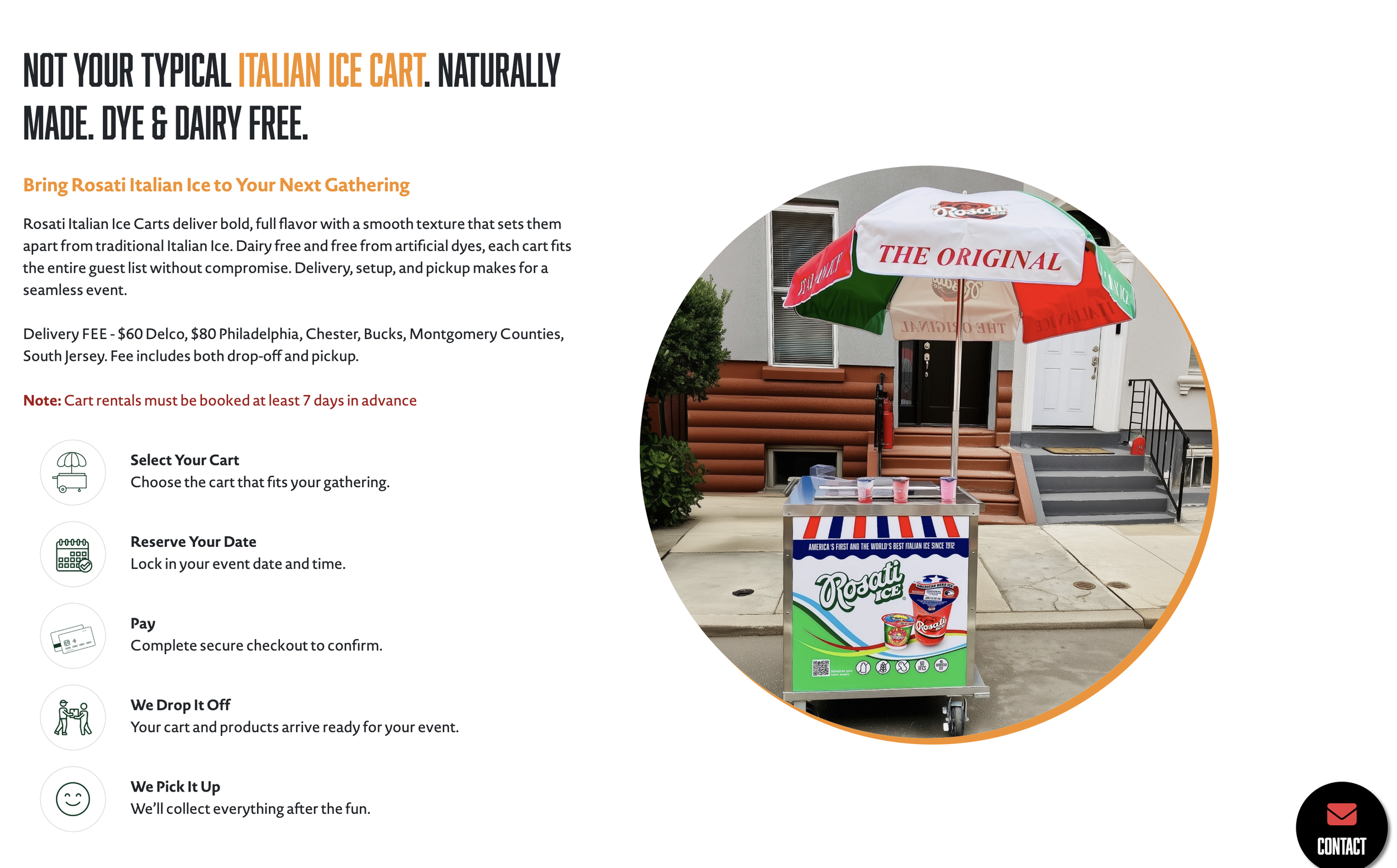
I used the competitive research to also think beyond the booking page and consider how the cart would feel when it arrived at an event. Both competitors built excitement through details like LED lights, music, custom menu boards, and nostalgic website copy. That showed me the rental experience needed to carry a sense of celebration from the first visit to the website through event day.
I brought that goal into my collaboration with the designer of the cart wrap. I gave feedback on color, typography, icon placement, and consistency with Rosati’s visual identity, then refined the design with the team over several rounds. Clear Rosati branding mattered because I had seen how the differently named vendor truck used for fundraisers could leave guests unsure who was serving them or what they were buying. The wrap was an opportunity to make the cart feel festive while making Rosati recognizable at the event without staff present.
Cart Wrap Design
As Rosati developed the cart rental program, I wanted people to see more than a cart and a list of packages. The brand was also shifting toward its “Natural” line, so I carried its dye-free, dairy-free, gluten-free, and major-allergen-free messaging reflected on the website and the cart into the marketing work. Those details could help someone planning a party feel more confident about offering Rosati to a group with different needs, demonstrating to our consumers that Rosati is inclusive for everyone and expanding our consumer base to include niche dietary needs.
I created story, carousel, and reel content to build awareness and show how the cart could fit into a celebration, working alongside the co-social media manager and content creator to keep the message consistent. With explicit permission from customers, I shared testimonials to build brand trust and awareness on social media. I additionally serve as a point of content for influencer collaborations to promote the cart rentals. Through virtual meetings I helped shape messaging and content ideas with local creators whose audiences ranged from 8k to 23k followers.
I also created local newspaper ads and drafted copy for the CEO’s script when he promoted cart rentals on Positively Philly, a Philadelphia news segment. Across each channel, I focused on connecting the excitement of having Rosati at an event with the practical reasons someone might choose it: an easy way to book, a recognizable brand, and an inclusive treat most guests could enjoy.
Social Media & Marketing
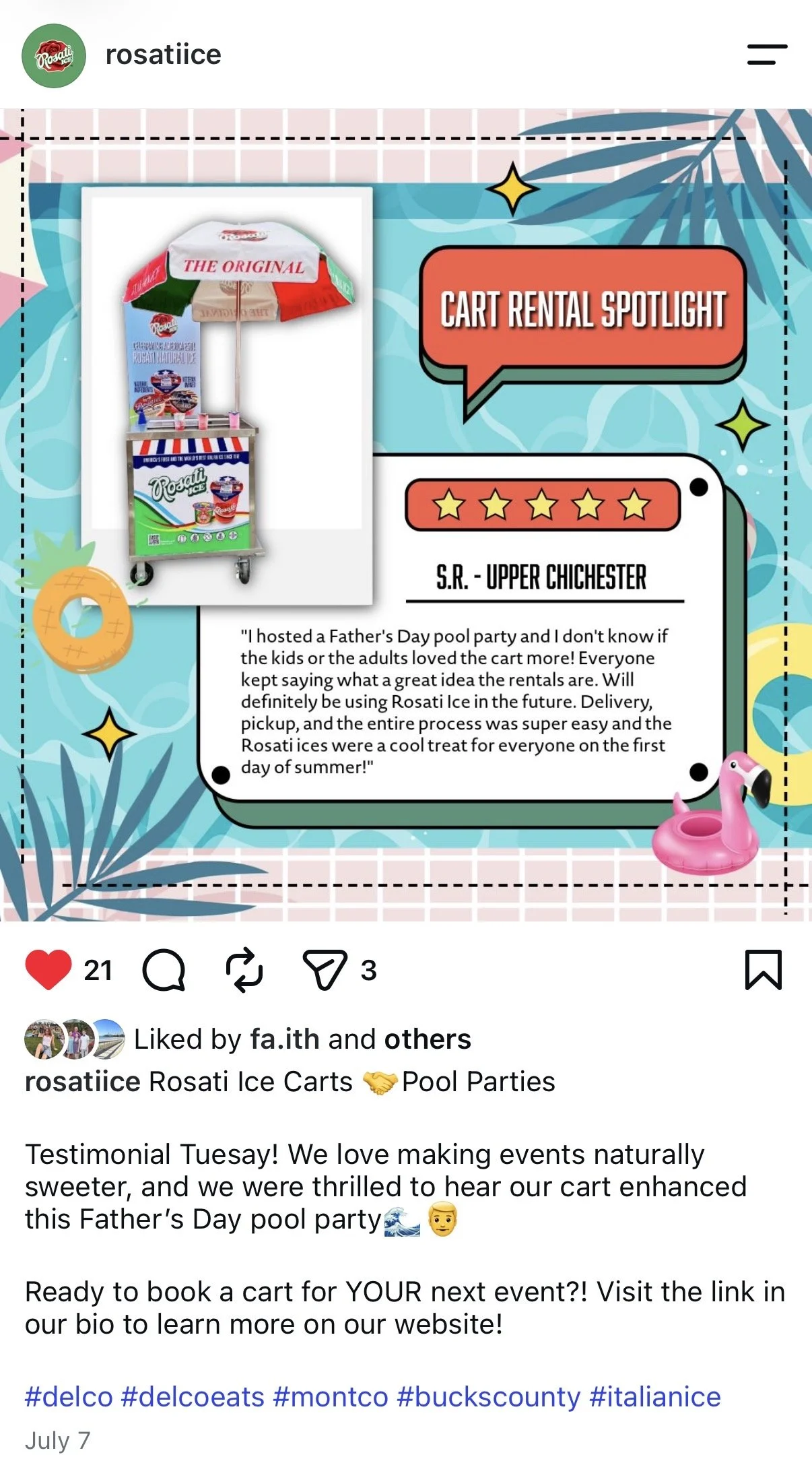
"Testimonial Tuesday" Cart Rental Spotlight for increased trust and awareness.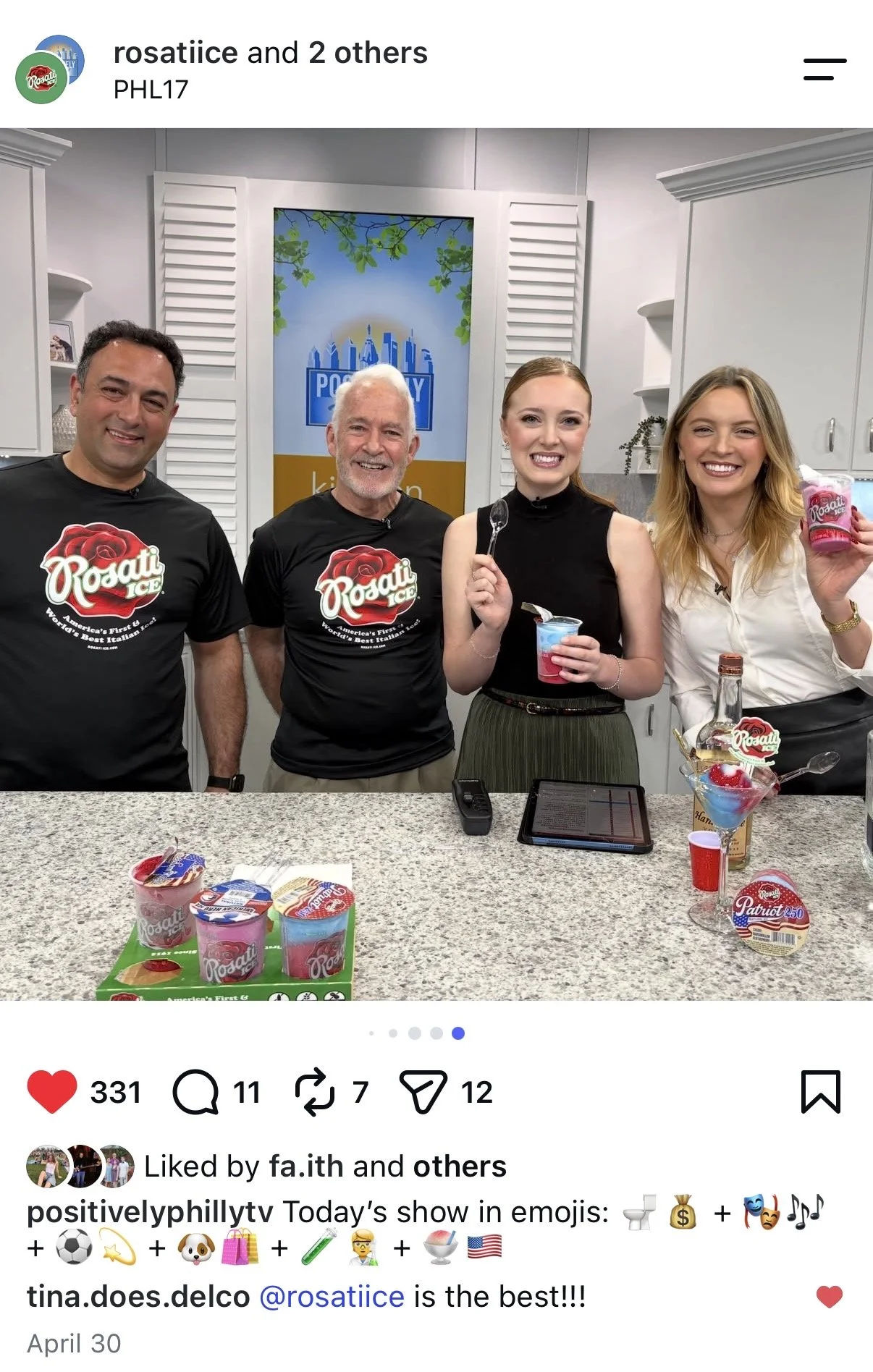
Positively Philly Appearance I helped draft messaging for.2027 Cart Rental Strategy Planning
August 2026 - Present
By late 2026, Rosati had four cart rental packages and an online path to book them. The customer-facing experience looked simple: choose a cart, reserve a date, pay, receive it, and have it picked up, and we had acheived the completion of 15 cart rentals in four months time. With four rentals we had to turn away, we were beginning to see pain points appear in real time.
The CEO wanted to understand what it took for Rosati’s small team to to grow the program in 2027 to an additional 50 rentals. I recommended a service discovery phase to address key stakeholders, their roles, their pain points, and how they collaborate to efficiently to get the job done. My goal is to map the work behind each rental so we could decide what to clarify, change, or automate based on real-data, not hypotheses. The CEO requested the strategy plan to focus on both service design execution as well as marketing. Currently I am in the early service design phase.
I wrote the Initial Steps plan as a two-page summary for Rosati Ice's CEO. In team meetings during the first half of 2026, I noticed that most friction in the cart rental program wasn't coming from coordination, not the website. A single rental moved through marketing, web, customer service, production, warehouse, delivery, finance, and management, and no one owned it from booking to pickup. I recommended treating cart rentals as its own service line with one accountable owner, and running a short discovery phase before any money went into redesign or marketing.
I based the approach on evidence-based service design practice, drawing on the Nielsen Norman Group for guidance. I laid out discovery in four steps:
Validate the current state through stakeholder interviews built on real rentals.
Shadow one rental end to end.
Interview recent customers.
Map and prioritize the findings in a service blueprint.
The order was deliberate. Each step tests what the one before it claims, so assumptions get checked before they shape design decisions. I also listed the decisions the CEO needed to make early: who owns the program, what's in scope, what the operating policies are, what a rental actually earns, and what the growth limits should be.
I built the plan as the first link in a traceable chain of documents. Every claim in it became a hypothesis in my Interview Guide, tagged as Confirmed, Unconfirmed, or Contradicted, and was then tested in my Stakeholder Synthesis. I used Claude as a synthesis partner to structure notes and cross-check claims against the rental schedule. My rule was that anything unverified got flagged, never treated as a finding, and I made the final calls.
The trail paid off. Several early observations were confirmed by two sources. One of my own prep notes was contradicted and corrected. And the question of who owns the program came back as the top open contradiction, which was exactly the decision the plan had asked the CEO to make first.
Service Discovery Phase
Rosati's cart rental process lived in people's heads, spread across a shared spreadsheet, inboxes, and phone calls. I needed interviews that would show how rentals actually moved through the business, not how people assumed they did.
I anchored questions in real rentals. Most questions point to a specific row in the rental schedule, and I made sure to carry questions regarding two previously executed rentals across all stakeholders to get a full picture of an event in progress. I asked the stakeholders to walk me through what they did and show me the email or spreadsheet they used.
I wrote down what each question was testing. A short "Testing for" note under every question kept each one purposeful. It also meant anyone on the team could run the interview.
I checked claims across stakeholders. When one person described someone else's work, I wrote a follow-up for that person's interview. I also asked some questions of two roles on purpose, like asking both Lou and the warehouse team about wrong deliveries. Each question has a status field (Confirmed, Unconfirmed, or Contradicted) that feeds straight into the validation log. I ordered interviews by how a rental flows, not by seniority, so each conversation could test the ones before it.
I kept pre-interview notes separate from findings. Deb shared informal notes before her interview. I turned them into specific probes rather than treating them as facts, so unverified claims couldn't slip into the findings.
I used Claude as a synthesis partner to cross-check the guide against the rental schedule row by row. I decided which gaps were worth asking about.
Phase 1: The Interviews
Sitting down with Deb, who coordinates rentals, and Justin, who runs the website, I learned that the cart rental program runs on people more than technology. Deb re-keys every order by hand into a shared spreadsheet she calls "gold," and production and delivery depend on it. Larger customers call instead of ordering online because the website can't handle their orders. The team makes it work through extra effort that the systems around them can't see, so any new system has to serve the people relying on that spreadsheet, not just online customers.
I utilize my psychology background to deeply listen, always wanting each person to feel heard, not audited. I grouped what they shared into eight themes and logged the contradictions to resolve before Phase 2. The biggest one, who is taking over the program, became the first decision I brought to the CEO. Where Deb and Justin disagreed, I designed around what each view protects. I also flagged where my own framing may have shaped an answer, something I am glad I caught and will be conscious about as I move into the next round of interviews.
I drafted a synthesis document in Claude, then added it to Gamma. I then transferred the presentation into PowerPoint to edit manually, applying our brand theme to provide a quick turnaround communication deliverable for the team and CEO of findings thus-far.
Immediate next steps include completing the interviews and synthesis. After the interviews, I'll close the gaps that conversations can't. I'll shadow one rental from start to finish to see how much time coordination really takes. I'll also compare website order records with the spreadsheet to measure how many orders happen offline, the one number that sizes the whole problem. Each finding will then move to confirmed or contradicted in the validation log. From there, I'll build what the CEO needs to plan Phase 2: a service blueprint and a prioritized list of fixes.
Next Steps
Let’s Connect!
Schedule a free 1:1 virtual coffee chat with me to discuss your UX design needs.
